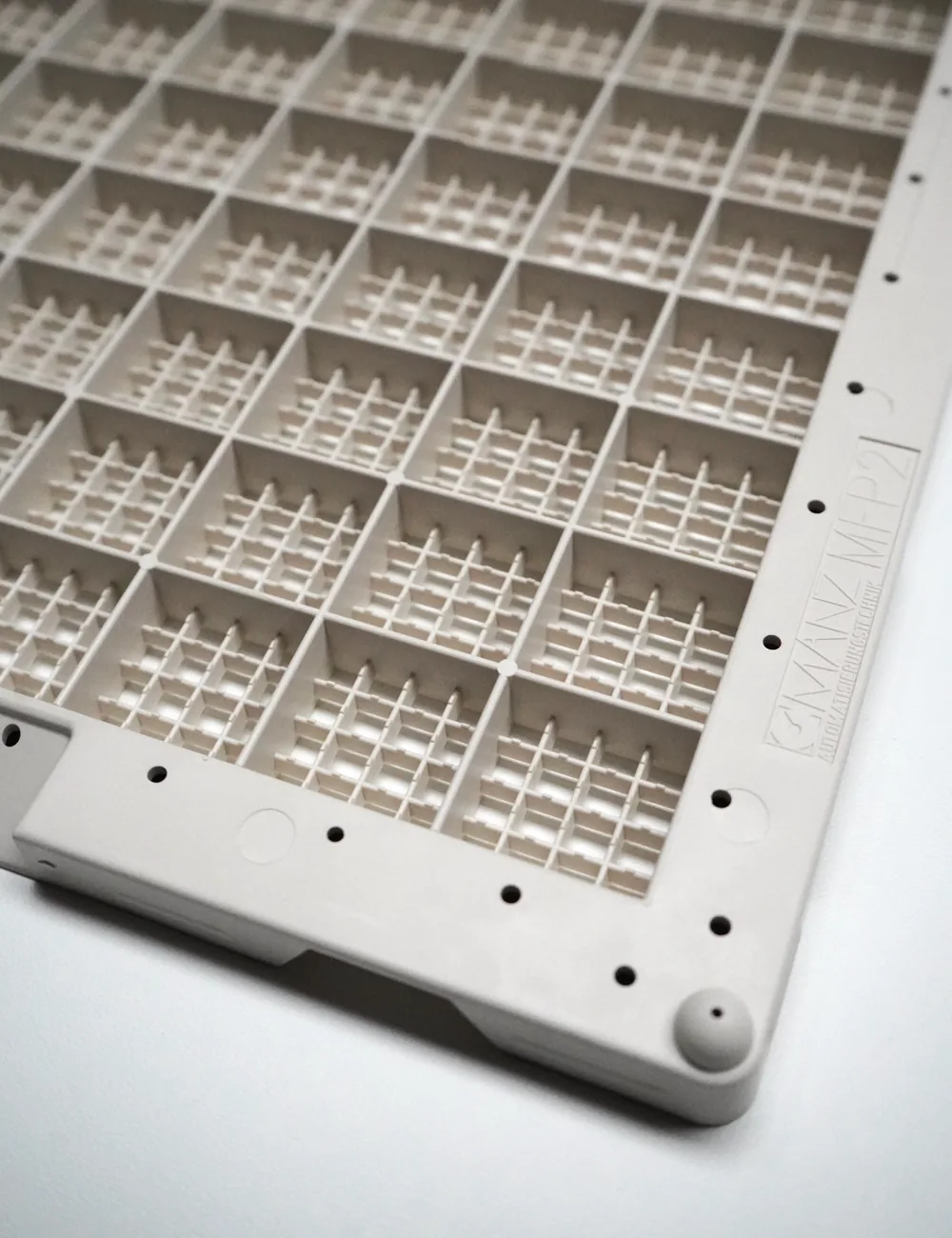
Describe the type of damage first
Which change should be avoided: scratches on a visible surface, chipping on an edge, deformation of a projection or contamination before the next step? This distinction matters because it leads to different tests. An insensitive outer surface may be suitable as a contact point, while a functional surface must stay free.
Distinguish rest from movement
A part can lie well when placed and move later. Describe the planned transports, lifting and setting down. Then check where the part actually rests. With a round workpiece, for example, watch whether it rolls; with a tall part, whether it tips. The decisive question is the condition after the process, not just immediately after loading.
Consider foreign particles
Even a suitable support can become a problem if particles get between carrier and part. So include checking and, where necessary, cleaning of the empty carrier in the process. Define how conspicuous pallets are sorted out. Damaged webs or deposits should not return to circulation unnoticed.
Make simple trials meaningful
Document the initial condition of the part under suitable conditions. Run the planned process with the intended carrier and check the same areas again. For a comparison, lighting, viewing and criteria should stay the same. For critical surfaces, the responsible quality assurance team decides which additional test is required.
Several parts in one pocket?
Placing parts together changes the situation. Parts can touch, overlap or jam each other. If this is planned, exactly this loading must be assessed. A test with a single workpiece cannot simply be transferred to several parts. It must also be clarified how completeness and removal are organised.
No blanket zero-damage promise
A photo of a loaded carrier does not prove a damage-free series process. Reliable statements refer to defined parts, conditions and tests. Record this link so that later changes to surface, loading or transport can be recognised and assessed specifically.
Document a sample test · Plan transport · Discuss your application