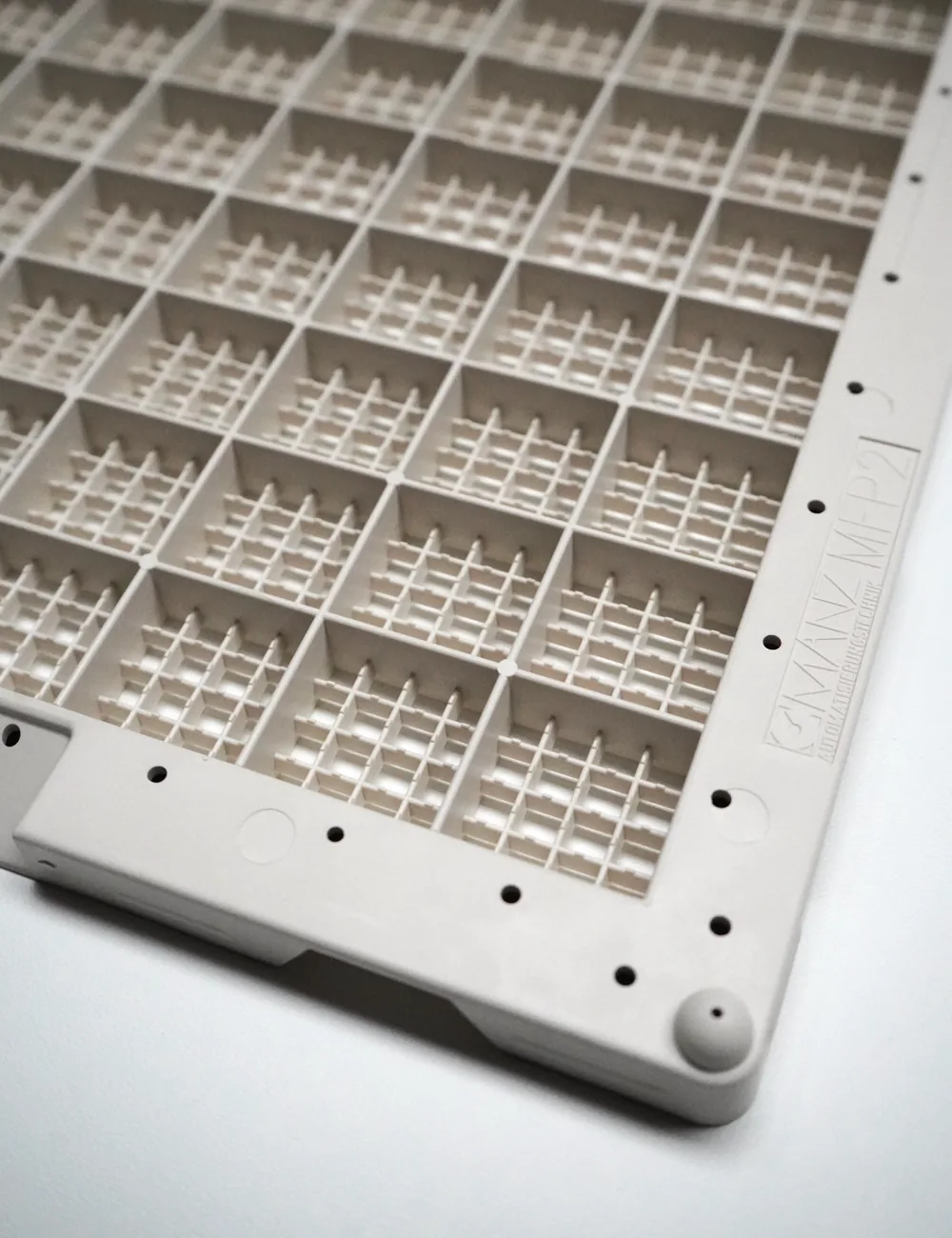
Which MFP model for which insert?
What counts is the largest footprint of the insert in its resting position – not just the inscribed circle. As a guide:
- MFP 0 (pocket 11.8 × 11.8 mm, 408 places): small square and round inserts.
- MFP 1 (17.7 × 17.7 mm, 204 places): common medium insert sizes and blanks.
- MFP 2 (27.8 × 26.1 mm, 96 places): larger inserts, including triangular geometries.
- MFP 3 and MFP 4: large inserts, special tools and tool bodies.
Triangular inserts need considerably more room than square ones with the same inscribed circle. If in doubt, we check the fit with a sample of your insert.
What task should the pallet perform?
Describe the specific section: intermediate storage after pressing, provision at a grinding machine or handover to packaging. For manual removal, a clear layout is the priority. For automated removal, what matters is the defined position of the insert and how the pallet is held in the machine – the side notch acting as an anti-rotation feature takes care of that.
Placing cutting bodies gently
Cutting edges are the most sensitive part of an indexable insert. In the MFP pallet, each insert lies in its own pocket and does not touch its neighbours. The grid structure of the pocket floor keeps the contact area small. For new geometries, still test a representative sample in its actual position – also after transport, because a round insert behaves differently from a square one in the same pocket.
A typical process
After a machining step, the inserts are placed in the pockets. The barcode label with serial number links the pallet to the order. The pallet moves to the next workstation, is cleaned in the ultrasonic bath if required and unloaded there – without transferring the parts. Before being reloaded, the empty pallet is checked and returned to circulation.
Observe the limits of individual process steps
MFP pallets are made of plastic and designed for washing and drying up to 89 °C. They are not intended for sintering, coating or other high-temperature processes – for these steps the parts are transferred to suitable sintering or charging carriers. We also agree on special media and mechanical loads with you in advance.
This information helps with the selection
- Geometry and dimensions of the cutting body.
- Permissible contact surfaces and sensitive edges.
- Process step before and after the pallet.
- Manual or automated removal.
- Existing MFP version or machine holder.
View MFP models · Enquire about your application · Understand component protection
Intralogistics solution for the tooling industry
Machine loading, transport and storage connect the stations of tool production. A uniform grid pallet makes this material flow predictable: the same footprint for racks and magazines, a defined position for robots and vision systems, one number for traceability. We tailor the pallet to your machines.