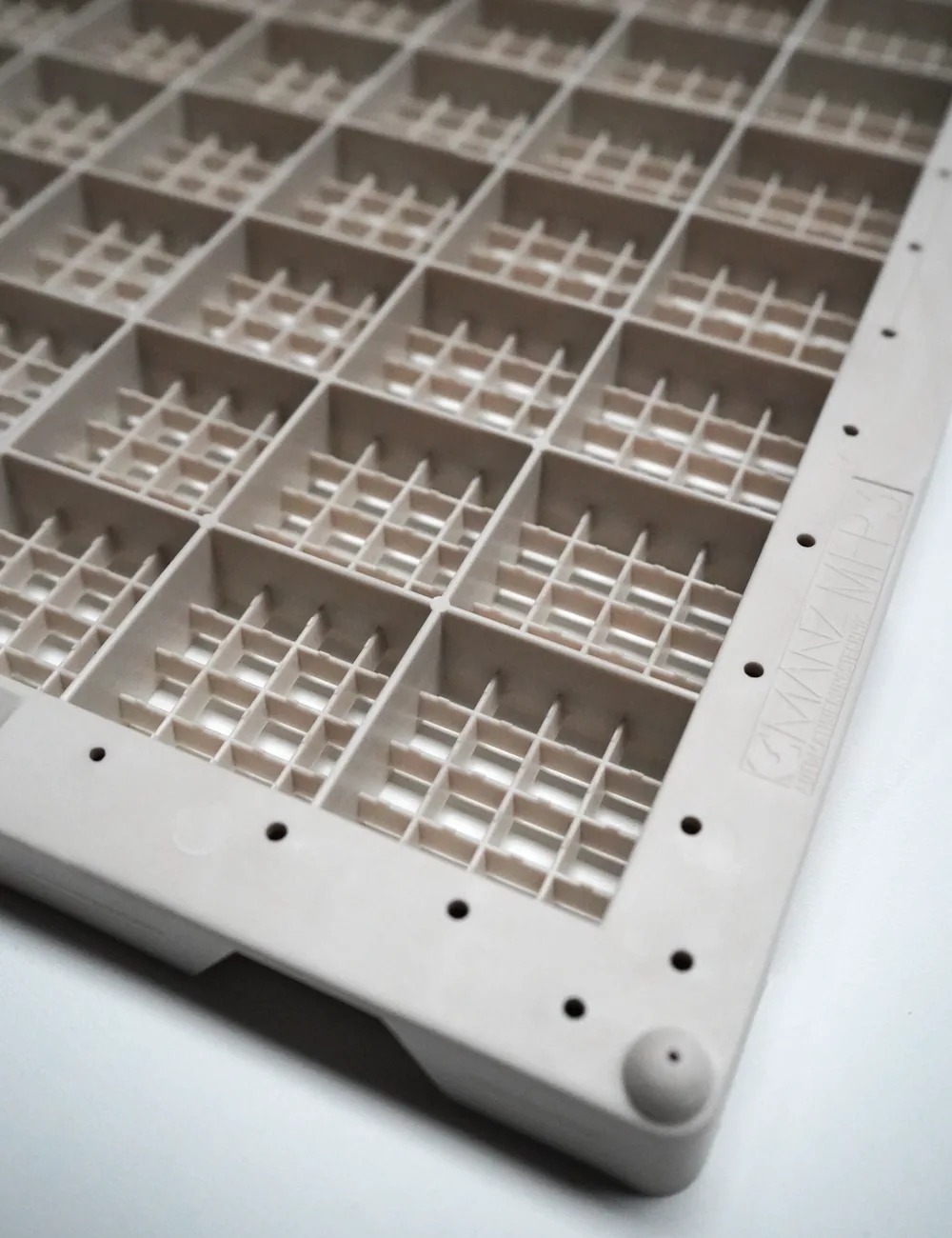
Identify the material clearly
Use the article number and the current product revision. Colour or model name is not a sufficient material description. Different data may apply even to similar-looking versions. So ask for the data sheet of the variant that will actually be used.
Name the medium precisely
Note trade name, manufacturer and intended concentration. A process sequence may involve several media, for example for cleaning and rinsing. List them separately. A statement such as “aqueous cleaner” describes the application only roughly and leaves important questions open.
Add temperature and time
A short exposure and repeated long contact are different load cases. So record duration, temperature profile and frequency. If an elevated temperature occurs only in one part of the system, this should be visible in the process. Also describe the phase after contact with the medium, for example drying or cooling.
Don’t ignore mechanical conditions
The pallet may be loaded, guided or moved during contact. This situation belongs in the assessment. An unloaded material sample does not automatically answer every question about the later carrier function. Support, total load and subsequent dimensional accuracy can be relevant for the application.
How approval becomes traceable
Combine product data, manufacturer information and, where applicable, test results in a documented decision. Note exactly which combination was assessed. An approval should not be transferred unnoticed to another cleaner, a new concentration or a changed drying process.
Six fields for your enquiry
| Field | Example of the information |
|---|---|
| Carrier | Model, article number, product revision |
| Medium | Product name and manufacturer |
| Concentration | Actual value in use |
| Temperature | Relevant profile including drying |
| Time | Duration per contact and repetition |
| Load | Loading, support and movement |
If data is missing
Mark unknowns explicitly. This makes it possible to decide specifically whether a data sheet, a manufacturer’s declaration or a trial is needed. An open question is better than a seemingly precise value from an unsuitable application.
Plan cleaning · Enquiry checklist · Technical coordination
Temperature: 89 °C for washing and drying
People often search for workpiece carriers with “heat deflection resistance up to 80 degrees”. For MFP flat pallets, the manufacturer specifies good temperature resistance for washing and drying up to 89 °C. This is a practical figure for cleaning systems. It is not the same as a heat deflection temperature according to a standard, which is measured under a defined test load. What counts for your process is therefore how long and under what load the pallet is exposed to the temperature.
Chemical resistance and dimensional stability
MFP flat pallets are more than just reasonably chemical-resistant: the manufacturer describes very good chemical resistance. There is no list of individual media and concentrations – which is why we check your specific cleaning agent with you before series use.
If you are looking for largely distortion-free pallets, MFP offers high dimensional stability and accuracy. This is especially important for automated picking, where every pocket position has to be right even after many cleaning cycles.