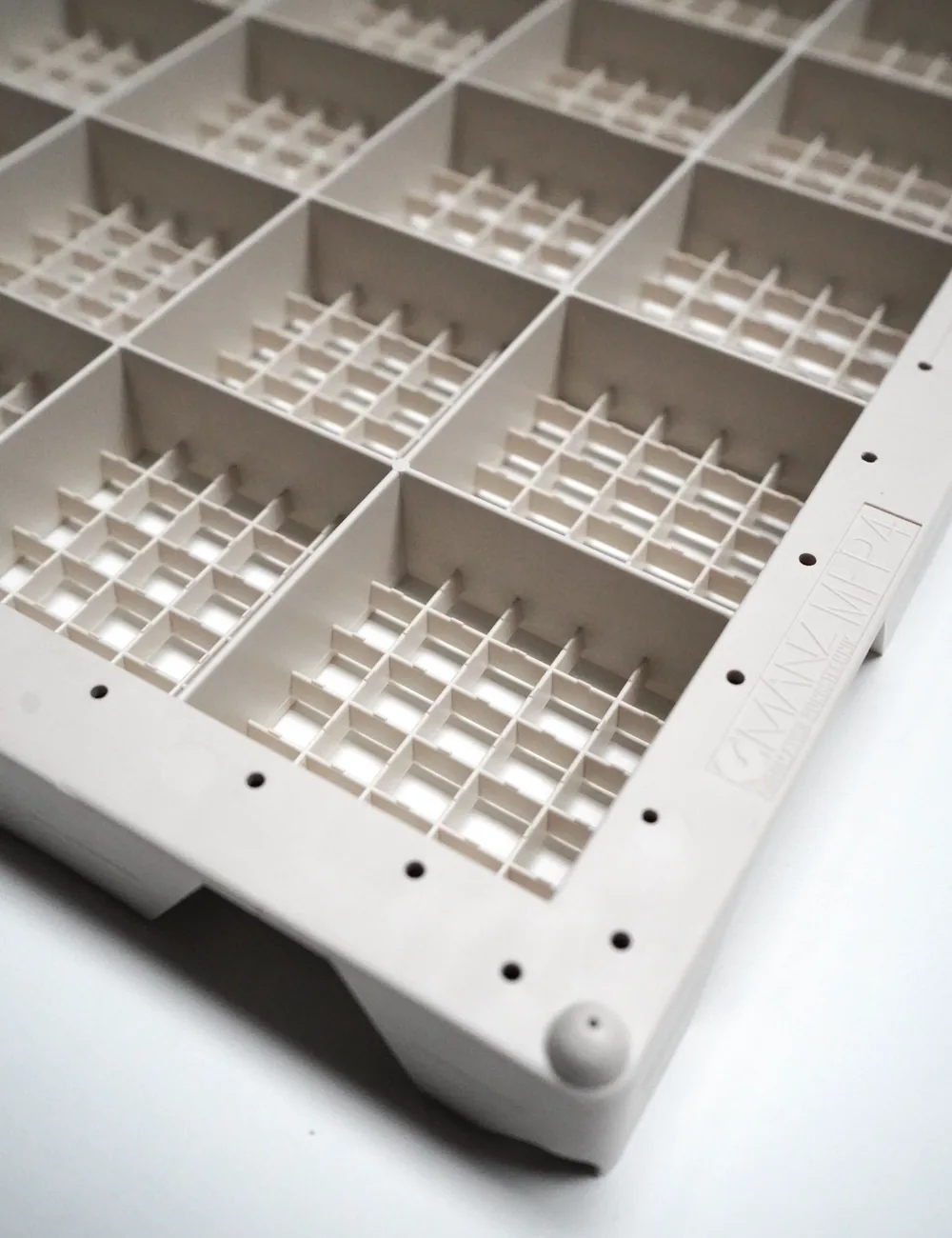
1. Position the pallet in the machine
Describe how the carrier arrives, is aligned and held. Which surfaces or features serve as references? Which deviations are permissible? This information belongs in an interface description. The outer dimensions alone are not enough, because they define neither the exact holding nor repeatability.
2. Understand the part position
A pocket limits a space but does not automatically fix every rotation or shift of the part. Check which positions can occur after loading and transport. This applies especially to round, flat or asymmetrical parts. The required picking accuracy determines how to deal with this variation.
3. Coordinate gripper and clearance
The gripper must reach the intended contact surfaces. Describe the approach direction, the space required and the path of the part out of the pocket. Consider neighbouring parts and pocket walls. A gripping test in free space does not fully answer this question; the trial should reflect the actual loading.
4. Define detection and occupancy logic
If the machine works with sensors or vision, define visibility conditions and states. What counts as an empty pocket? How is a wrong position detected? What happens if a part has not been picked? These functions belong to the overall system and are not provided by the pallet alone.
5. Test the restart as well
A series process includes interruptions. After a stop, the assignment of parts already picked and parts still present must be correct. So don’t just test a fully loaded carrier in uninterrupted operation, but also partial loading and defined fault situations. The people responsible for the machine determine the tests required.
A helpful handover document
Summarise the drawing revisions of carrier, part and gripper. Add the position references, the occupancy pattern and the relevant process conditions. Record changes traceably. This lets carrier supplier, integrator and production refer to the same status.
What MFP compatibility means
An existing use of an MFP pallet is a valuable starting point. But it does not automatically prove that every variant fits every machine. For a specific assignment, article number, holder and application must be considered together.
Parts handling as an application · Understand pocket geometry · Prepare your enquiry
Compatible with your machine?
People often search for pallets that are “compatible with all common machining equipment”. The MFP system is suitable for a variety of machining equipment and designed for automation with its anti-rotation notch, fixed grid and standardised stacking systems. Whether it fits your machine depends on pallet holder, referencing, gripper and part position – we are happy to check this with you or your integrator.