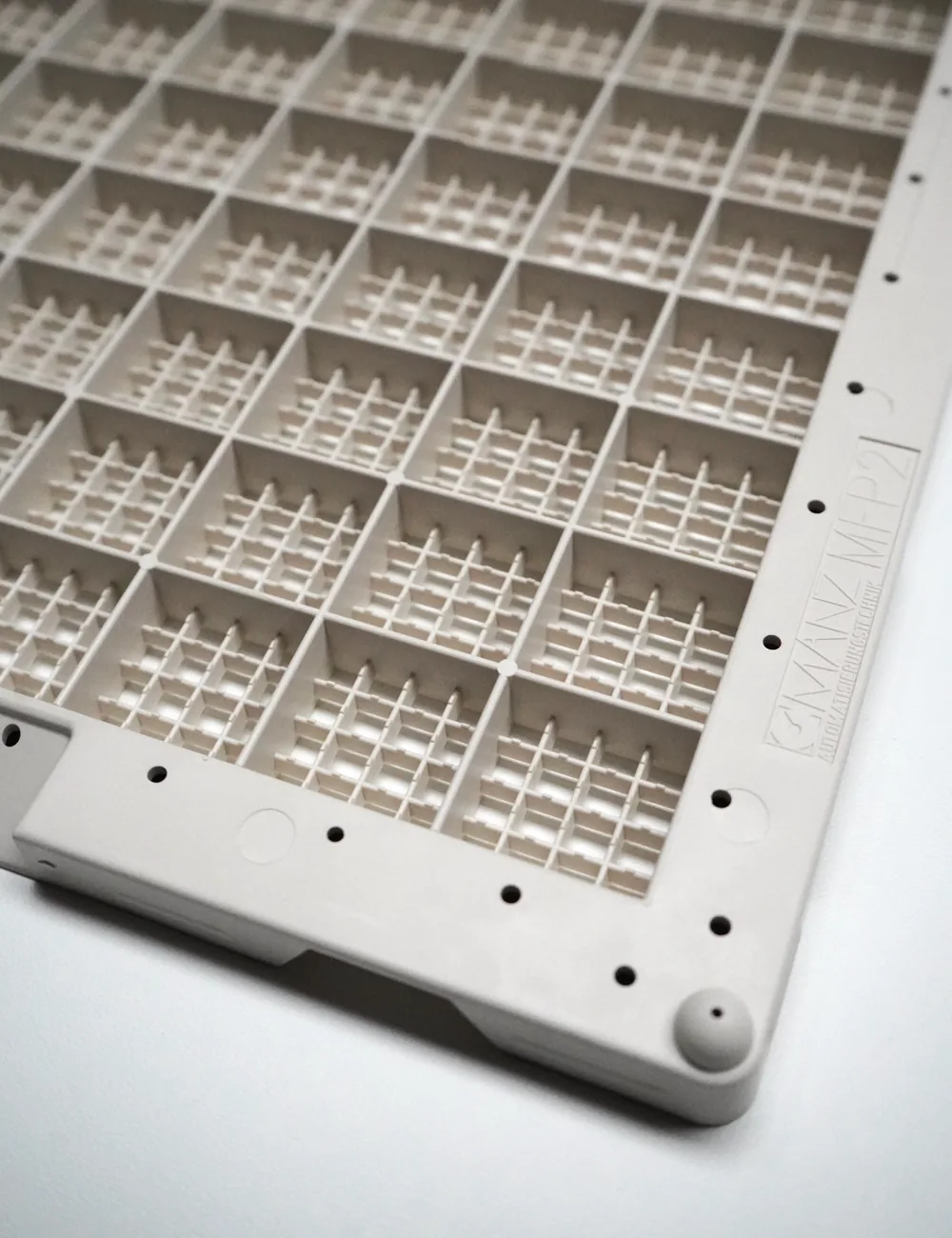
Four figures for a first estimate
You need the throughput q in parts per hour, the actually usable occupancy n in parts per carrier and the cycle time t in hours. Add a planned reserve r. The cycle time starts when the carrier is provided for loading and ends when the same carrier is available again. Waiting and return times must be included.
The simplified formula
Basic carrier requirement = q × t / n.
Planned stock = round up(basic requirement × (1 + r)).
This calculation is suitable as a first approximation for a reasonably even cycle. It is not a simulation of complex production. Separate product families, batch processes and bottlenecks may require a more detailed analysis.
Example not related to a specific MFP model
A process handles 480 parts per hour. A carrier is actually loaded with 40 parts. Three hours pass from the start of loading until the carrier is available again. A reserve of 20 percent is used as a calculation assumption.
- Basic requirement: 480 × 3 / 40 = 36 carriers.
- With reserve: 36 × 1.20 = 43.2 carriers.
- Rounded up: 44 carriers.
The values are freely chosen planning assumptions. They describe neither an MFP capacity nor a generally recommended reserve.
Why actual occupancy counts
Don’t simply use the theoretical number of pockets. Some positions may stay empty because a gripper needs access, an order is smaller or a special loading is planned. In the example, an actual occupancy of only 30 parts increases the basic requirement to 48 carriers and the planned stock with the same reserve to 58.
Waiting time is cycle time too
If carriers wait for inspection or collection after a process, they are not available for new loading. Observe these times in operation. It often makes sense to make avoidable waiting times visible first, before simply buying more pallets.
Justify the reserve
A reserve can be planned for fluctuations, cleaning, inspection or rejected carriers. Set the value based on your data. Document the assumptions and later compare the calculation with the observed cycle. This turns a first estimate into continuously improving planning.
Download the process mapping template · Compare cost efficiency · Send a quantity enquiry