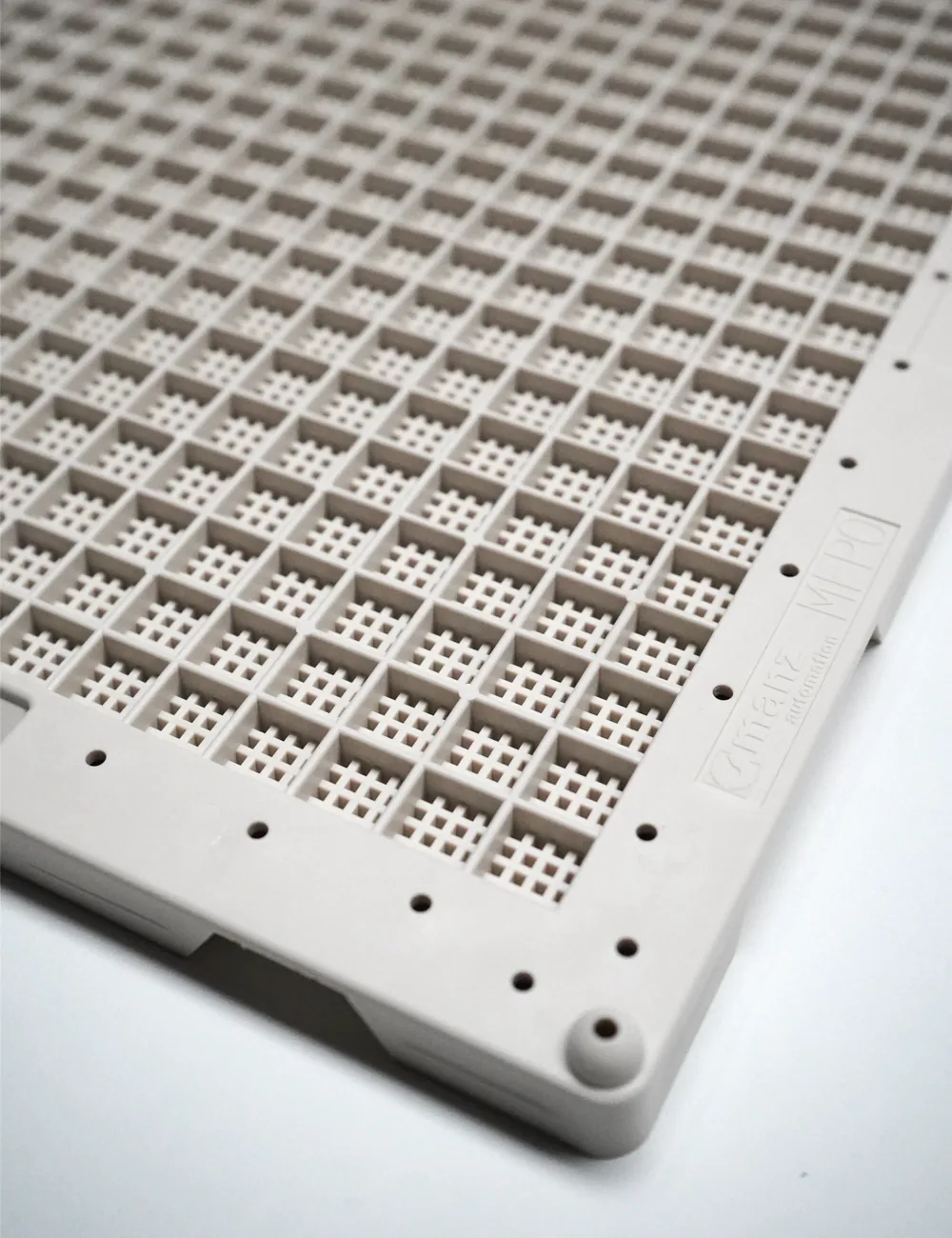
Getting started
If you are choosing a workpiece carrier for the first time, start with the selection guide and the article on pocket sizes. For a reorder, the MFP comparison helps. If a specific process is already defined, the articles on cleaning, automation or transport lead directly to the relevant questions.
All guides
Choosing workpiece carriers: a guide in seven steps
Seven steps to the right workpiece carrier: clarify the part, pocket geometry, removal, process conditions and sample testing systematically.
Comparing MFP 0 to MFP 4
Compare MFP models by article number, pocket geometry and application. Distinguish clearly between reordering and technical selection.
Pocket size, grid pitch and part position explained
Distinguish pocket size and grid pitch: look correctly at usable space, part position, tolerances and removal clearance in workpiece carriers.
Protecting sensitive small parts in workpiece carriers
Plan component protection: assess contact surfaces, changes in position, contamination and transport in the workpiece carrier together.
Workpiece carriers in industrial parts cleaning
Plan parts cleaning: consider loading, contact points, cleaning medium and result checks when using workpiece carriers.
Drying small parts in workpiece carriers
Assess drying after parts cleaning: consider residual liquid, part position, contact points and further processing.
Checking material, temperature and media resistance
Assess workpiece carriers under real conditions: bring together material, medium, concentration, temperature, time and mechanical load.
Planning workpiece carriers for automated picking
Automation with workpiece carriers: plan referencing, part position, gripper access and restart as connected interfaces.
Stacking and transporting workpiece carriers
Plan support, loading, stacking and transport routes of workpiece carriers. Assess empty and loaded pallets separately.
How many workpiece carriers do you need?
Estimate the need for workpiece carriers: throughput, actual occupancy, cycle time and reserve with a traceable example.
Comparing the cost efficiency of workpiece carriers
Look at the costs of workpiece carriers over their use: purchase, cycle, handling and care with a transparent calculation example.
Standard workpiece carrier or custom solution?
Weigh standard carriers against custom solutions: compare geometry, process, quantities, reordering and the effort of changes systematically.
Sampling workpiece carriers: from sample to approval
Prepare sample tests of workpiece carriers: test questions, representative parts, process conditions and traceably documented results.
Linking workpiece carriers, orders and batches
Plan identification in the parts cycle: distinguish carrier identity, order, batch and inspection status and keep them at handovers.
ESD, cleanroom and sensitive processes explained
ESD, cleanroom and sterilisation are different requirements. Which evidence you need for sensitive workpiece carrier applications.
Checklist for a complete MFP enquiry
Request MFP flat pallets efficiently: record model, article number, part data, process, quantity and date with a practical checklist.
Planning the handover of workpieces to packaging
From workpiece carrier to packaging: organise article assignment, quantity, removal and remaining parts clearly at the handover station.
Terms and quick answers
In the glossary we explain important terms from workpiece logistics and parts handling. The frequently asked questions bundle answers about products, selection and enquiries. For practical implementation, the download area offers checklists you can fill in.
Applying the knowledge to your own application
The articles explain selection criteria and planning processes. Specific product values belong to the selected version and its current data sheet. Record the conditions of your application and use this information for technical coordination.
Technical data from the Manz data sheet
Manz MFP data sheet 08/2020: dimensions and properties – all five models with outer dimensions, pocket sizes and capacity, plus information on ultrasonic cleaning, temperature, stacking and identification.