1. Describe the part completely
Record the largest outer dimensions, the weight and the intended position. Add sensitive edges, coated surfaces, projections or bores. Mark on a drawing which areas may be touched. For a family of parts, don’t just look at an average example but at the variants that are least favourable for holding.
2. Narrow down the task
Should the carrier store, transport, provide or pass through a cleaning process? Note every station up to removal. If several tasks come together, the selection must be assessed for the complete intended process. Also decide whether the pallet is returned empty afterwards or reused with remaining parts.
3. Assess the pocket geometry
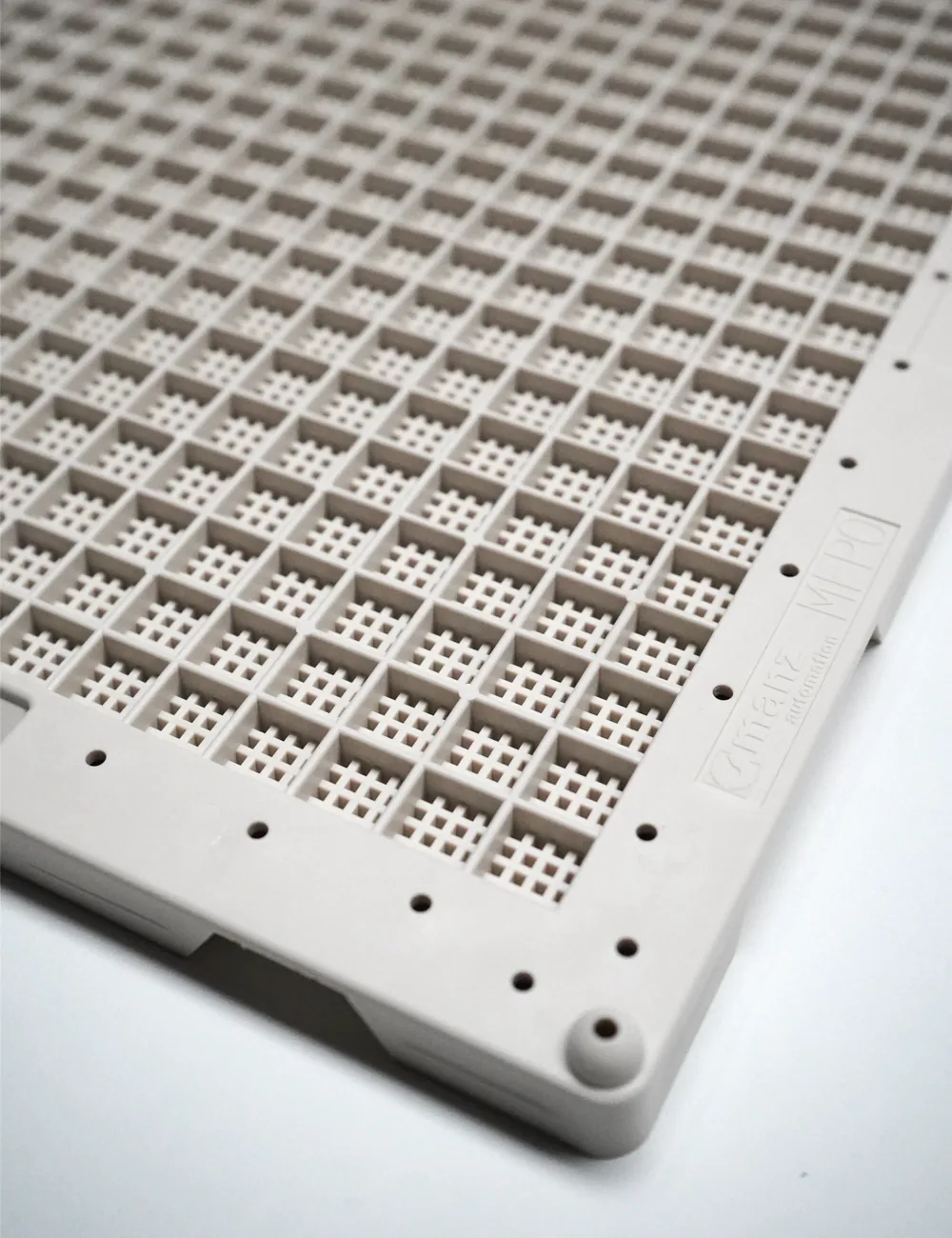
Compare the usable contour with the part. Besides the footprint, height, support and clearance count. A part must not be considered suitable just because its outer dimensions are smaller than a nominal pocket size. The actually usable geometry can be influenced by radii, webs and the chosen position.
4. Plan the removal
A hand, tweezers and a robot gripper need different access. Define where the part is gripped and in which direction it is removed. Automated processes add the permissible positional deviation. Test removal after the planned transport as well.
5. Record the process conditions
Describe contact with media, temperatures, times and mechanical effects. For electrical or cleanliness requirements, name concrete specifications. General adjectives such as “robust” or “clean” are not enough for a technical selection.
6. Bring documents and samples together
Request the current documents for the specific version. Use the same article number in drawing, order and test report. A sample adds practical experience in your own process to the documents. Record what was actually tested and what is still open.
7. Document the decision traceably
The approval should link part revision, carrier variant and process conditions. If one of these elements changes later, you can assess specifically whether the evidence still applies. This makes reorders easier and prevents experience from different applications from being mixed up unnoticed.
A useful starting point
Create one page with a picture of the part, the most important dimensions, a short process description and the three biggest open questions. This compact description is often more helpful for a first conversation than a long, unsorted collection of documents.
Compare MFP models · Prepare a sample test · Send an enquiry