Look beyond the industry
The term “precision part” does not yet describe a holding geometry. A ring, a bush and an irregular milled part differ in support, centre of gravity and removal. So record the actual shape, permissible contact surfaces and the transport conditions. This gives you a reliable basis for selection.
Three questions for the first assessment
First: can the part be held in an intended position? Second: does it stay in an acceptable condition during the planned processes? Third: can the next workstation reliably take it over? A positive answer to the first question does not yet answer the other two.
State special requirements early
For electronic components, electrical properties can be decisive. In sensitive production, requirements for cleanliness, residues or documented materials may be added. Mention such requirements in your enquiry right away – then we can clarify which version and which evidence are possible.
Start with a manageable trial
Choose representative parts and define the aim of the test in advance. A first trial can look at placing and removal. Further relevant steps are then added. Document open questions and name who has to assess the results. This way, a new application can be made concrete step by step.
What we need for coordination
Helpful are a drawing or photo, dimensions, weight, material and a process description. Add requirements for surface and cleanliness. If a customised carrier might be needed, this should be assessed using the same criteria; the availability of a special version has to be clarified separately.
Standard or custom carrier? · ESD and sensitive processes · Describe your application
Traceability for medical technology
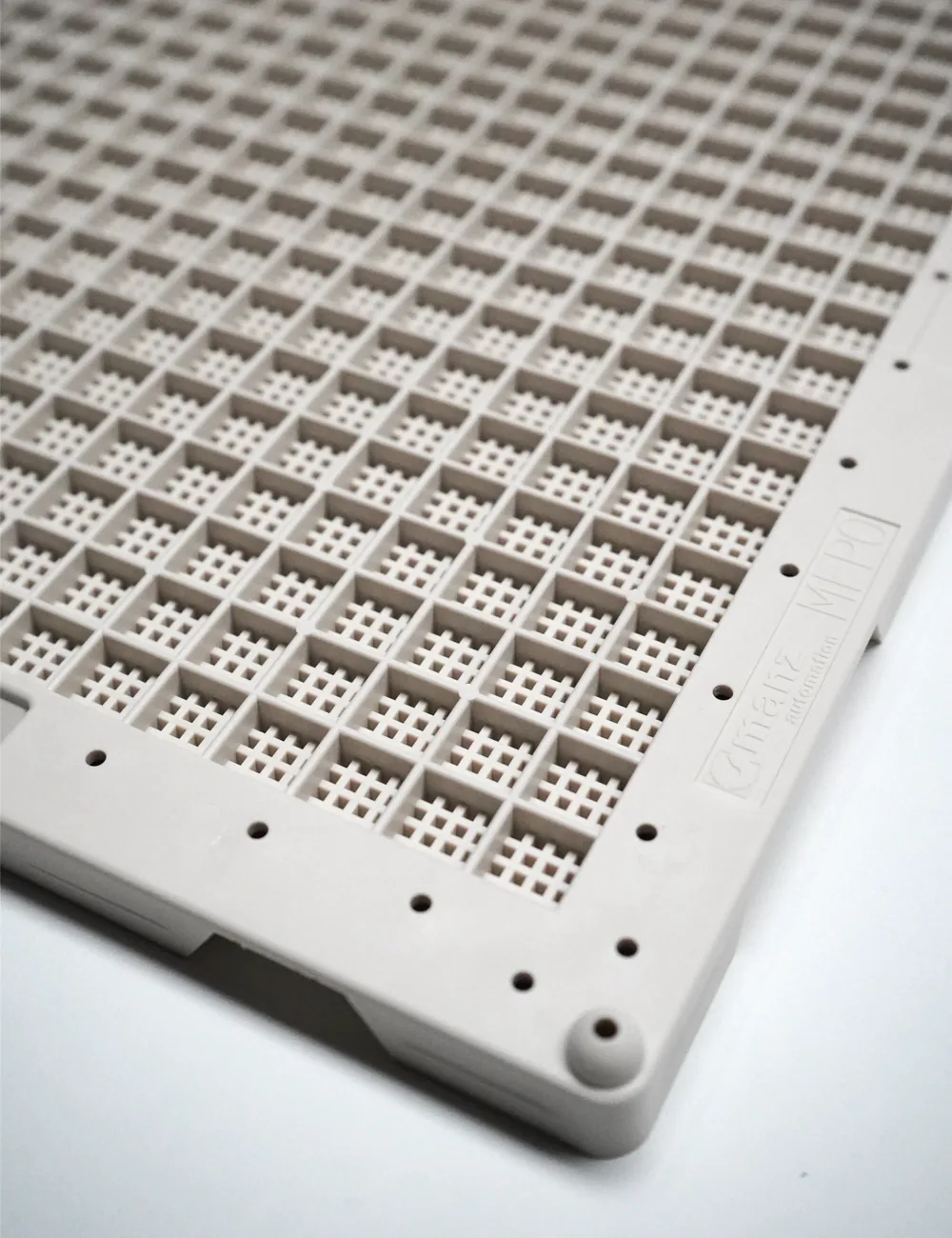
For medical technology, MFP pallets can be retrofitted with an RFID chip. This allows every pallet – and therefore every batch of parts – to be tracked through the process, an important prerequisite for complete documentation. We agree requirements for cleanroom or sterilisation with you separately.